Know how your money is doing.Every month, without doing the accounts.
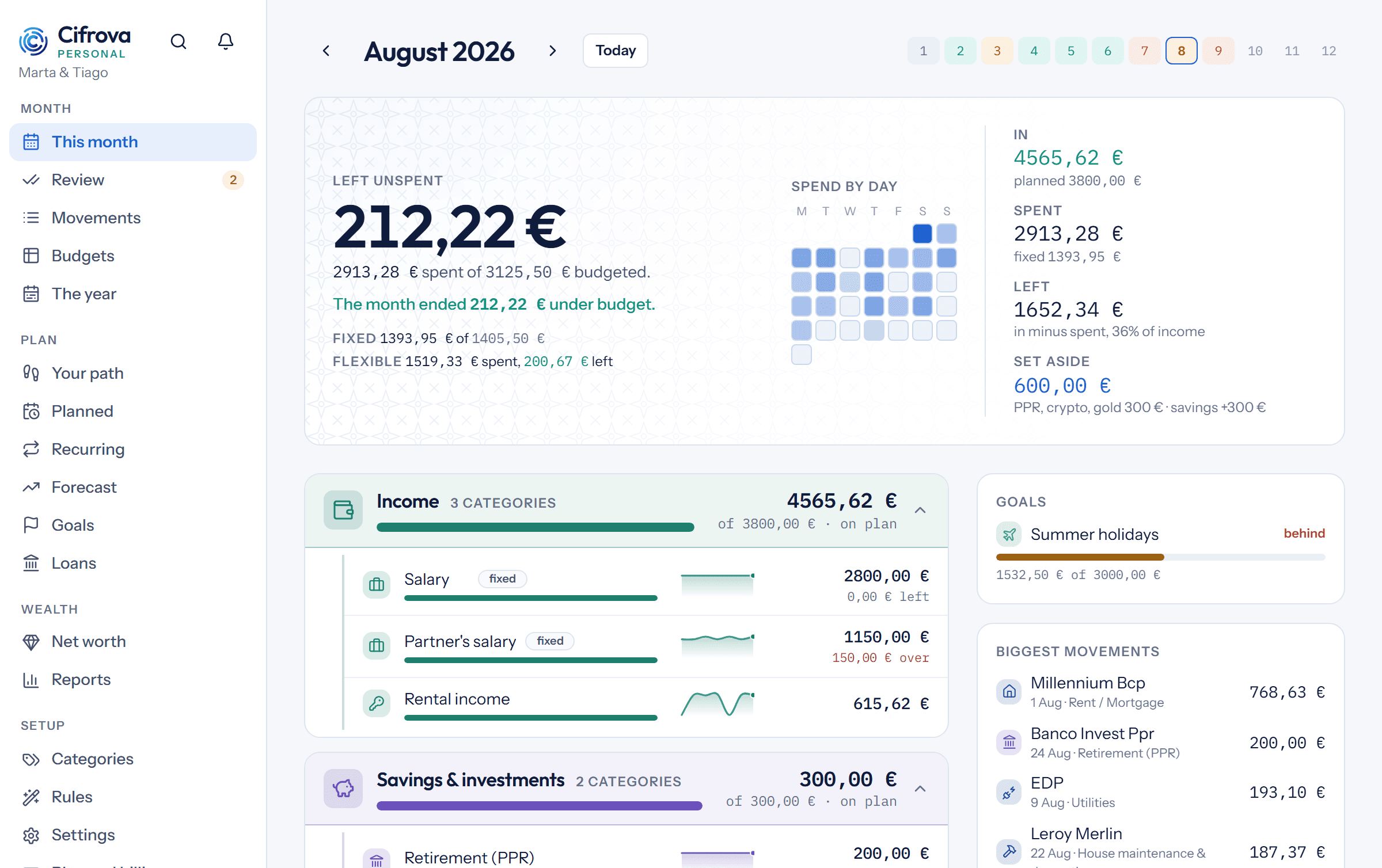
Cifrova connects to your bank accounts, sorts every movement on its own and tells you, in one number, how much you have left this month. On Sunday you get one short email. Over the years, you get a very different balance.
Most families cannot say, give or take 200 €, what they spent last month.
If you can, honestly, you do not need us. If you cannot, you are not careless: you have 150 bank lines a month written in capital letters, three accounts, two cards and a spreadsheet nobody has touched since March. The money you cannot account for has not disappeared. You just cannot see it. And money you cannot see slips away.
Ten years is long enough for a small leak to become a house deposit, a year off work, or nothing at all.
The difference between those futures is not willpower. It is seeing the number early enough to do something about it. A subscription you forgot about costs 9 € a month, which is 1 100 € over ten years. Groceries that run 15% over plan cost you a holiday a year. And a mortgage payment that leaves on the 30th costs you a scare on the 27th, every single month, unless something has already counted it for you.
Cifrova exists so that the number is always in front of you, without you having to do the accounts.

I grew up without anyone teaching me about money.
Not at home, not at school. Nobody explained what a budget was, what interest does over ten years, or why the small leaks matter more than the big purchases. I learned it the way most people do, by getting it wrong, and I got it wrong for years. I run operations for a living, and for a long time I kept better books for the companies I worked for than for my own family.
When I finally sat down with our own numbers, the lesson was uncomfortable. If I had seen them ten years earlier, we would be in a different place today. Not because of luck or a bigger salary. Simply because we would have known early enough to decide.
Cifrova is the tool I wish someone had handed me at twenty-five. It does the accounts, so all you have left to do is decide.
Four assistants come with the house.
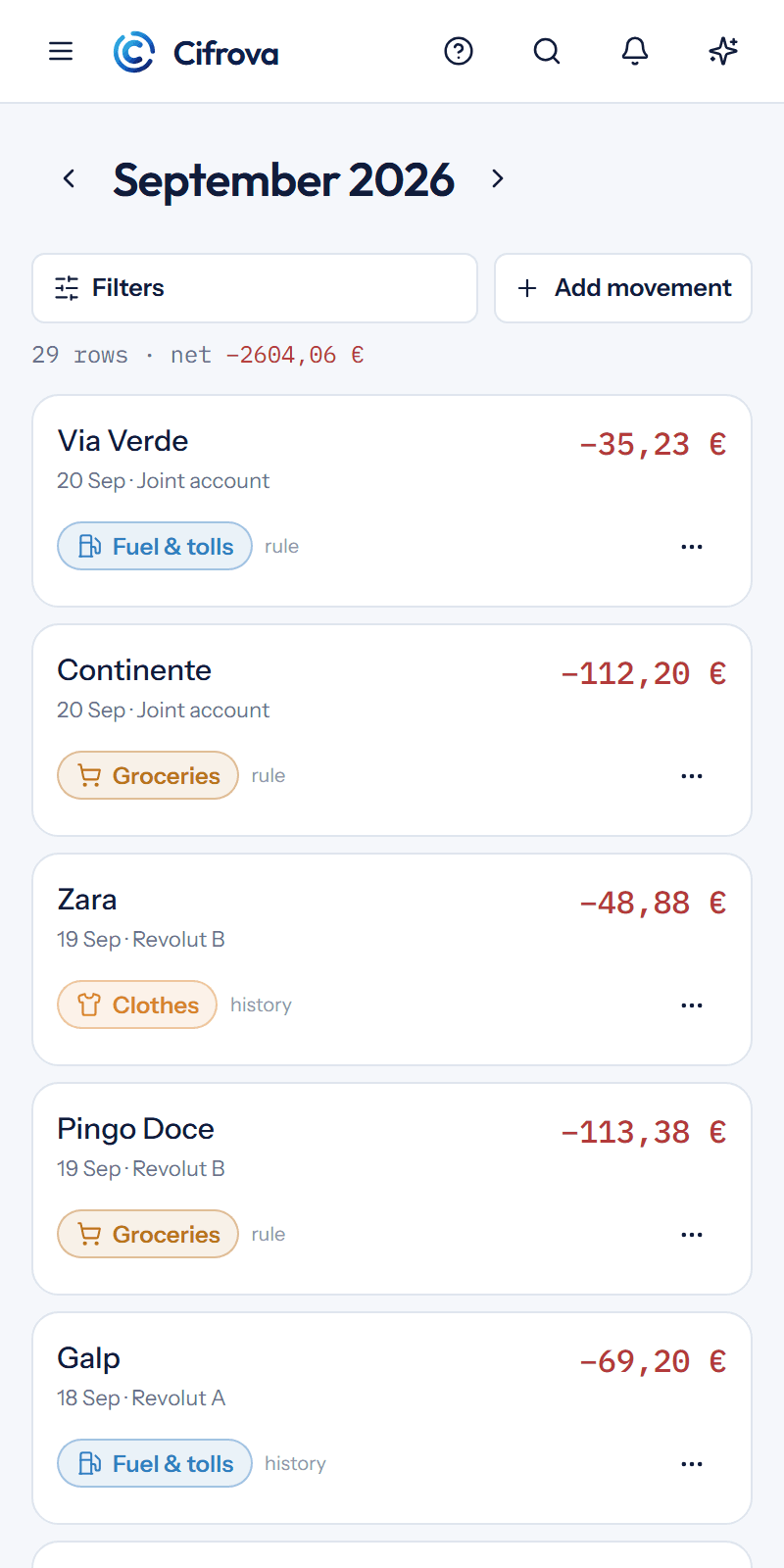
Each new shop or company is read once; the answer becomes a rule, so it never asks twice. What it is not sure about waits in Review with a suggestion and a one-tap Yes.
Pick a method (the debt-free path, 50/30/20, zero-based, the long-term investor) and ask up to forty questions a month. A monthly letter and a coach line in the Sunday email. Every figure from your own accounts.
Five questions, one minute, and the app places you on the classic steps: a safety net, the debts, a real cushion, the future, the children, the house. It watches the line every night and tells you the morning you cross it.
One screen: where the month stands, what needs you (only if something does), the one-tap answers, what lands this week. If the subject says nothing needs you, nothing does.
The assistants see bank lines and your category names, nothing else, and do not train on them. Switch any of them off in Settings.
Six things you will have by next Sunday.
- One number you can trust. How much is left this month, whether you are on track, and what you can spend per day until payday. Fixed costs and the ones you control, shown separately.
- Nothing to type in. Your bank sends the movements every morning and rules sort them. When a shop or company shows up for the first time, Claude is asked once where it belongs, and never again. Everything it decides is visible and easy to change.
- One email on Sunday. If the subject line says nothing needs you, nothing does. If something does, you answer it with a tap, straight from the email.
- A warning before the balance gets tight. Ninety days ahead, per account, from what you have planned and what usually happens. You see the lowest point before you move money.
- Your whole picture in one figure. The house at market value, the mortgage as it goes down, PPR, funds, crypto and gold at today's prices. Updated on its own.
- Made for two people. A joint account and personal cards, kept apart the way you keep them. Money you move to a personal account counts as your share, not as an expense.
Fifteen minutes to set up. Then it runs on its own.
Pick it from the list, say yes on your bank's own site and come straight back. We never see your login details. If your bank is not on the list, import a statement.
Ninety days of movements come in. Claude looks at each shop or company once and suggests where it goes. You approve the list, and from then on the rules do the work.
The budget starts from what the last few months actually cost. Change any line, for any month. Then Sunday comes, and so does the email.
Thirty days free, with everything switched on. Then pick one of three.
The bank connection, the budget, Claude sorting the movements, the Sunday email. Two members.
Try it freeEverything in Cifrova Personal, at a price that never goes up for as long as you keep it. Three hundred places, then the offer closes.
Try it freeSee how it compares with a spreadsheet, YNAB and Wallet. The founders offer is explained on its own page.
Thirty-day money-back guarantee on your first payment, no questions asked. The Advisor, a method with a monthly letter and questions answered from your own numbers, is an optional add-on at 6,90 € a month. All the details.
The ones everyone asks.
Is it safe to connect my bank?
Yes. The connection is read-only and happens at your bank, through a company licensed under the European open-banking rules (PSD2). We never see your login details and nobody can move money. The consent lasts 90 days, and the app reminds you ten days before it runs out.
What does the AI see?
Bank lines (date, amount, description), the names of your categories, and, if you use the Advisor, a summary of your budget. It goes to Anthropic's Claude, which does not train on your data. It is asked once per new shop or company, not on every movement. You can use your own key if you prefer.
My partner has their own account. Does that work?
That is exactly the case it was built for. Joint accounts feed the budget; personal cards can be kept separate, so a transfer to a personal account counts as that person's share instead of showing up as an expense.
What if my bank is not supported?
Import a statement (CSV, or a PDF for Millennium cards) and everything else works the same. We keep adding banks.
Can I leave?
Any time. Cancel in one click, export everything as files, delete your household and it is gone from the live database straight away and from backups within 30 days.